
November 10 2026
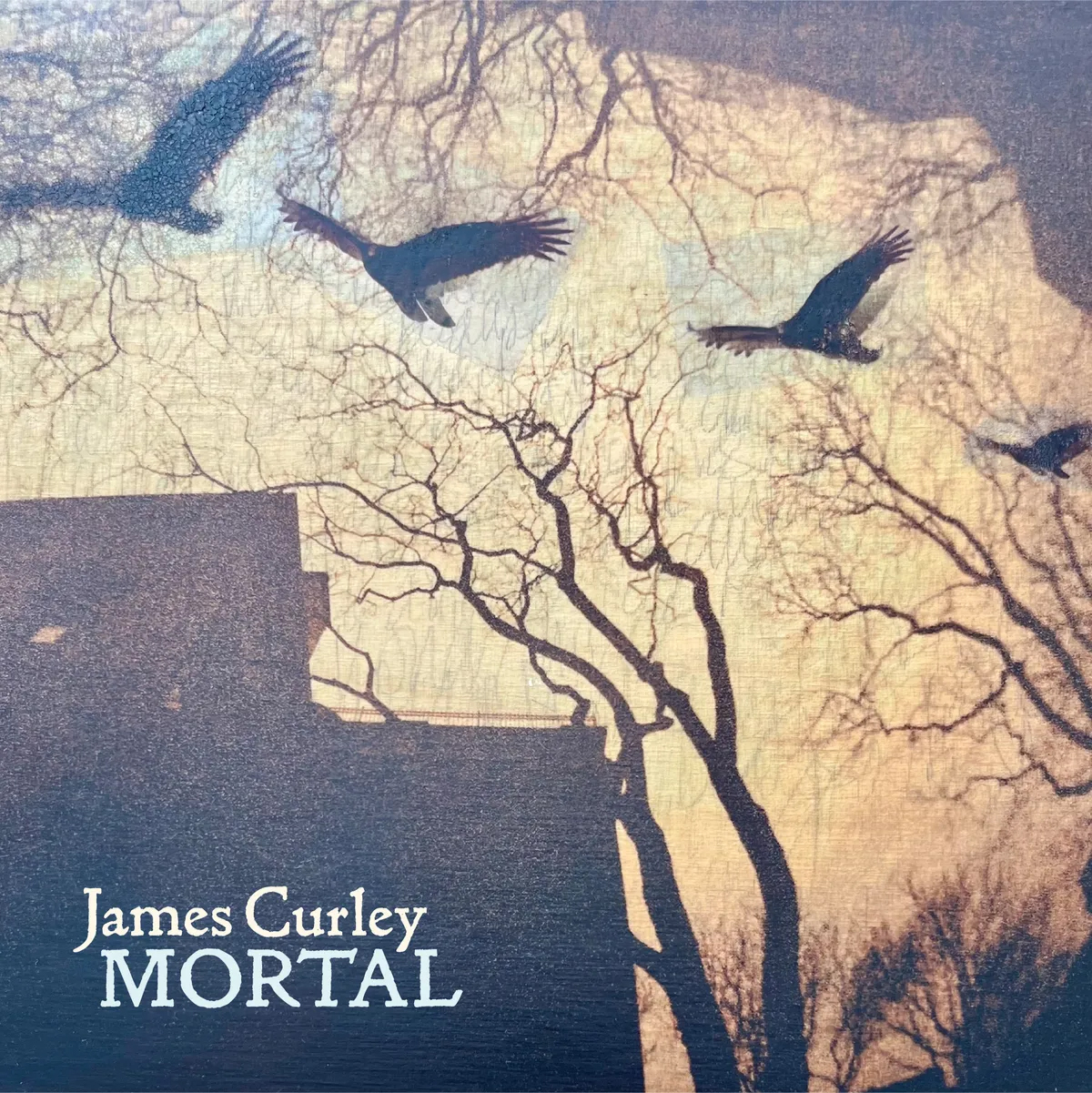
James Curley
Mortal - Sidewalking Crab
By JIm Hynes
James Curley is a Chicago-based singer-songwriter who has been an instrumentalist, bandleader, writer, and singer of folk and Americana music for 50+ years. He is blessed to have the acclaimed John Abbey as his producer for Mortal/ (Sidewalking Crab Records). Originally recorded on just Curley’s acoustic guitars, he and Abbey recruited a skeleton crew to deliver a stripped-down sound with pedal steel (Brian Wilkie), accordion (Violet Moore), and drums (Gerald Dowd). Jenny Elenemann sings harmony on two tracks. Abbey fills in the gaps with a variety of instruments. While Curley’s voice isn’t especially distinctive, he’s easy on the ears, and he writes several dark songs with conviction. He dedicates the album to strong women he’s encountered in his life. Mortal was written over the decade preceding its recording, a period defined by the deaths of Curley’s spouse of 37 years, his mother, and a beloved niece. The arc of the album traces the emotional arc of grief, recovery, and rediscovery, ultimately arriving at a place of gratitude and clarity.
Curley begins with the confessed admission that he didn’t do enough to help the addicted female friend Anna, in “Anna Tried,” who he described as especially stubborn. He then addresses mass shootings in “Better Angels,” borrowing the title and inserting lyrics from Abraham’s Lincoln’s inaugural address in 1861. Curley borrowed a quote from Abraham Lincoln's inaugural address in 1861: “The mystic chords of memory, stretching from every battlefield and patriot grave to every living heart and hearthstone all over this broad land, will yet swell the chorus of the Union, when again touched, as surely
they will be, by the better angels of our nature.” He ends with “We need help to stop the madness/We need common ground.” The country-infused, pedal steel-driven “Song to Myself” is a respite, a breath of optimism - “open up the windows, unlock the doors…” He stresses the joy of being alive, reassuring us we are not alone. Similarly, he asks us to be grateful in the acoustic-strummed “When the Universe Throws You a Bone.” “Song for Marrying Moon Do?” ruminates on the hopeful future of a strong family life. The curious “What Does the Moon Do” is an introspective song using planetary metaphors to describe the relationship. The surprisingly upbeat “Bitter When I’m Old” is the only song he didn't write, credited apparently to a family member. Wilkie’s pedal steel drives the tune, a takeoff on the inside cover quote from William Butler Yeats (Sailing to Byzantium) - “An aged man is but a paltry thing. A tattered coat upon a stick, unless. Soul clap its hands and sing, and louder sing. For every tatter in its mortal dress.” Curley continues to reflect on the passage of his mother and his Irish heritage in “Come Home To Tir na n0g,” the traditional place referenced in so many folk songs. (There’s a great version on Van Morrison's (No Guru, No Method, No Teacher). It’s a place of eternal youth where there is no pain or sorrow. Curely urges patience and restraint along with
eternal love in the closing “I Am Here For You.”
Mortal begins on the dark side but eventually embraces more hopeful life lessons while addressing those he loves along
the way. It’s a thoughtful album that bears multiple listens.

Jim Hynes is an independent contributor on music for several magazines, including Elmore and Country Standard Time. He has also written for Variety. He was a listener-supported public-station radio host for 25 years in CT, MI, NJ and PA. He is also a Live music host/Emcee at several national and regional venues.
To Read All of Jim's Reviews, Click Here